#modernism

Page 11

St Augustine’s Catholic Church, Manchester, 2024

A group of people stand in line outside St Augustine’s Catholic Church, a modern brick building with tall vertical columns, large windows, and a circular religious symbol beside the church name on the exterior wall under a cloudy sky.
A modern church altar features a large, abstract metal sculpture of Jesus with outstretched arms against a textured, swirling backdrop. The altar is adorned with green cloth, candles, flowers, and a cross. Several people stand or sit near the edges of the scene.
A close-up of an intricate wall sculpture featuring an abstract mix of wood and dark textured materials, with geometric shapes, raised patterns, and protruding wooden blocks arranged in a visually dynamic, layered design. Light casts dramatic shadows, enhancing the depth.
A narrow stained glass window with a grid pattern of red, yellow, orange, and clear glass panes, set between dark brick walls. Light filters through the colorful glass, casting a warm glow in the otherwise dim space.
A lobby with terrazzo floor, wooden ceiling, and glass windows. Yellow-tinted glass panels partially cover the windows, with views of an outdoor area and bike racks. A wooden table, a black bench, and a fire extinguisher are visible inside the lobby.
A view inside a dark auditorium showing rows of rectangular, illuminated windows high on the walls. Below, a pipe organ and some chairs are partially visible on a stage, with the ceiling and lighting fixtures overhead.
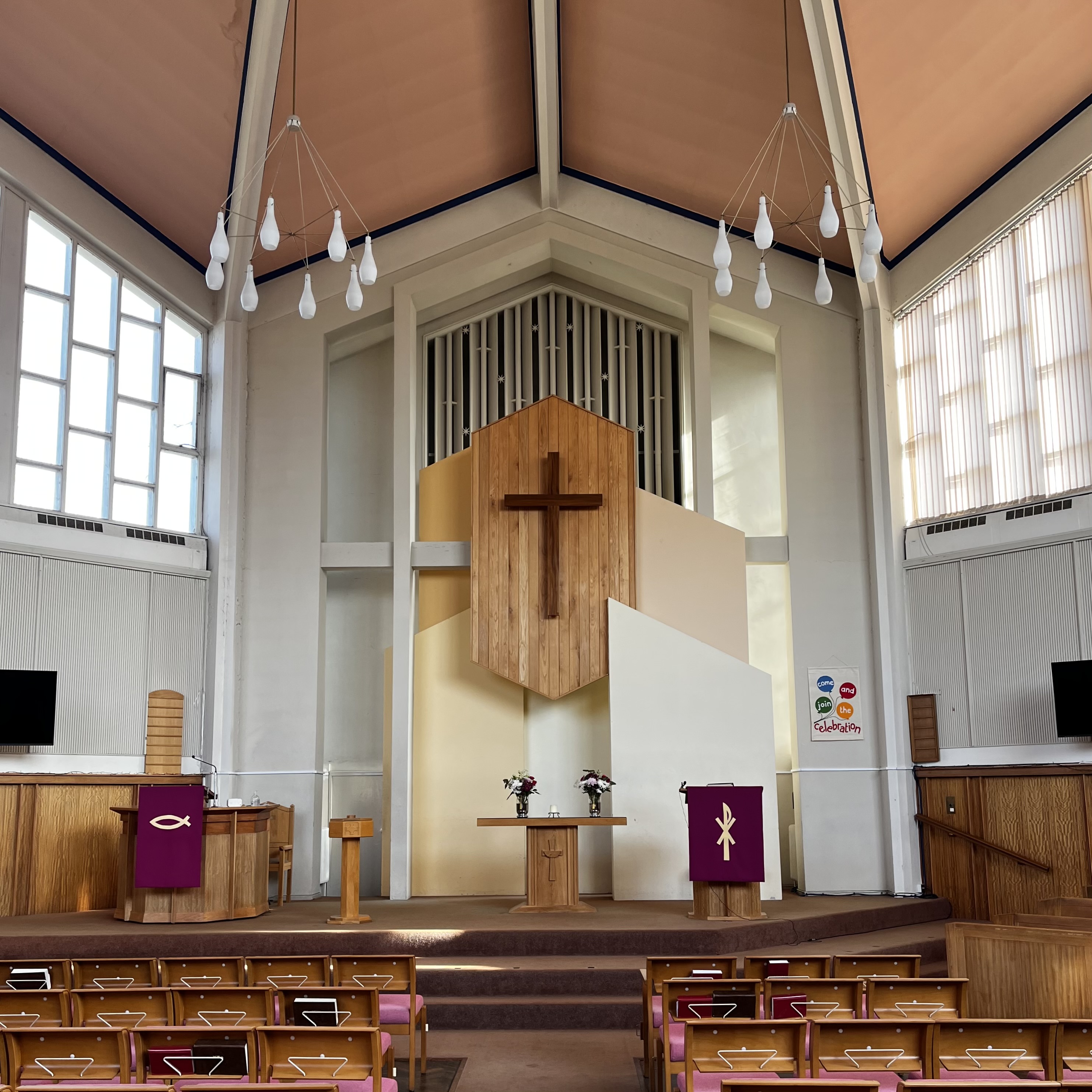
A modern church interior with wooden benches and a high wooden ceiling. People gather near the altar, which stands before a large, textured wall relief featuring abstract designs and a prominent lamb symbol. Warm lighting illuminates the mostly empty, spacious nave.

I’ve walked past it loads of times but I never realised how nice the interior is.

There’s also an ad for marriage counselling at the back, which provided great amusement when I stopped to take photos of this church on a previous walk with my boyfriend, much to his chagrin.

Beales department store, Bournemouth, 2024

A large, curved, multi-story brick building with many horizontal windows stands on a busy city street. The sign reads “Beales.” People walk and sit in the foreground. The sun creates a bright halo behind the building under a partly cloudy sky.

The massive, looming presence of the Beales building, a former department store in Bournemouth.

Having gone bust in 2020, the Twentieth Century Society writes:

A planning application to convert most of the building to residential use was refused in 2016 because of a wish to retain retail floor space in the town’s primary shopping area against a backdrop of a sizable public campaign to retain Beales as a store – “I back BEALES.”

Look at how well that worked out! In July 2024, the building has been granted planning permission to convert it into housing with gym and pool, as well as three ground floor retail units. These will surely be of similar architectural value as those in Bristol & West House.

Sherborne Library, 2024

A single-story building with a sign reading “Sherborne Library” stands behind tall hedges. A road in the foreground has STAFF ONLY painted on it. The sky is clear and blue, with autumn trees and trimmed grass visible around the library.

Audibly gasped when I saw the sign, the font feels very of the era with a quality modern fonts don’t have anymore.

On the Brasília of the North

A yellow exhibition poster features black text reading “Brasília of the North,” dates, and a surreal illustration of curved modernist concrete buildings on a grassy field under a cloudy sky. A floating letter D block hovers above the structures.

That brings our trip to Newcastle to a close. The last thing I wanted to highlight was the Brasília of the North exhibition at the Farrell Centre. We kindly got a preview of it the weekend before it opened, so my photos of it are not fit for public consumption, but I definitely recommend it.

An exhibition exploring the ideas, personalities and broader social, cultural and political climate that underpinned the aspirations to transform Newcastle into a modernist city.

It runs until 1 June 2025, is – ̗̀free ̖́- to visit, and included in it are several large scale models of Newcastle itself as well as select buildings in it – if that doesn’t sell it, I don’t know what will.